
Digital Health: when the challenge is no longer innovation, but implementation
In recent years, digital health has become one of the main drivers of transformation in the healthcare system. Technologies such as artificial intelligence, telemedicine and remote monitoring systems have been part of the healthcare innovation debate for decades.

In recent years, digital health has become one of the main drivers of transformation in the healthcare system. Technologies such as artificial intelligence, telemedicine and remote monitoring systems have been part of the healthcare innovation debate for decades.
However, factors such as demographic change, growing pressure on health systems and, particularly, the impact of the pandemic have accelerated the need to adopt many of these solutions in real-world care settings. Rather than a sudden emergence of new technologies, what has occurred is a change in the context and urgency of the system, which has fostered greater adoption capacity and placed digital health in an increasingly central position within the healthcare debate.
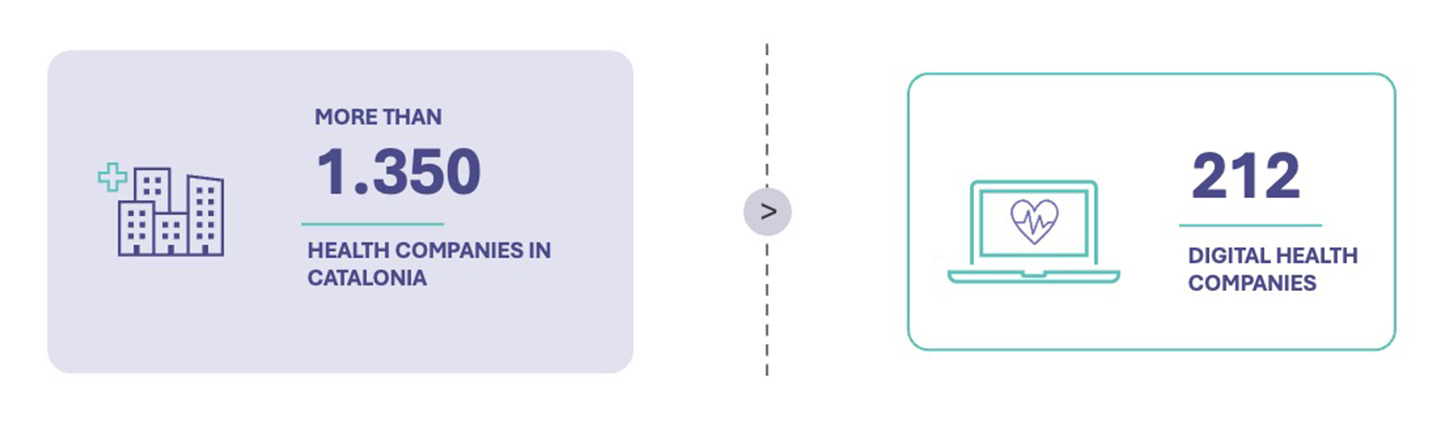
The digital health ecosystem has grown steadily in recent years, both nationally and in Catalonia. According to a report by Biocat’s BioRegion, Catalonia’s health sector comprises more than 1,350 companies, including 212 companies linked to digital health. These figures reflect an increasingly consolidated ecosystem, with the capacity to generate economic activity, attract investment and develop solutions with real-world applications in healthcare.
Nevertheless, the growth of the ecosystem does not eliminate some of the structural difficulties associated with implementing innovation in healthcare. The challenge is not so much the existence of technology or projects with potential, but rather the complexity of transforming solutions validated through pilots into scalable and sustained adoption within the care system.
This difference is not minor, as it means moving from an approach focused exclusively on technological development to one capable of integrating the real conditions for adoption within the healthcare system. This includes not only care processes and the different stakeholders involved, but also the ability to build sustainable business models from an operational and economic perspective. Ultimately, for an innovation to become established, demonstrating its clinical value is not enough; mechanisms must also exist to make its implementation and long-term sustainability viable.
One of the clearest manifestations of this mismatch is the proliferation of pilots that fail to scale. Solutions are developed that work in controlled environments and generate evidence and interest, but do not become established as part of the system. As stakeholders indicate:
«We pilot a lot, but scale very little.»
This situation is not due to a lack of clinical validation of the solutions, but rather to a lack of definition of their pathway to adoption. In many cases, projects are structured with a focus on technical or clinical demonstration, without integrating from the outset the elements needed to develop a business model: purchasing mechanisms, integration into care processes, economic sustainability, regulatory and legal compliance, and professional adoption.
This point is particularly relevant because technology is not introduced into a neutral environment. The introduction of digital solutions entails changes in ways of working, task distribution, patient management and decision-making. It also requires the system itself to define more clearly its priorities, needs and adoption criteria, an aspect that still presents a certain degree of ambiguity and generates uncertainty for both healthcare providers and innovative companies. Without this adaptation and alignment, even technologies with the greatest potential may fail to become established as real, transformative solutions.
In this regard, healthcare professionals’ perceptions are a determining factor. Digital tools can be perceived as a solution or as an additional burden, depending on how they are integrated into day-to-day work. Their participation in the development and implementation process is key to ensuring effective adoption.
These considerations are compounded by structural barriers that constrain scalability:
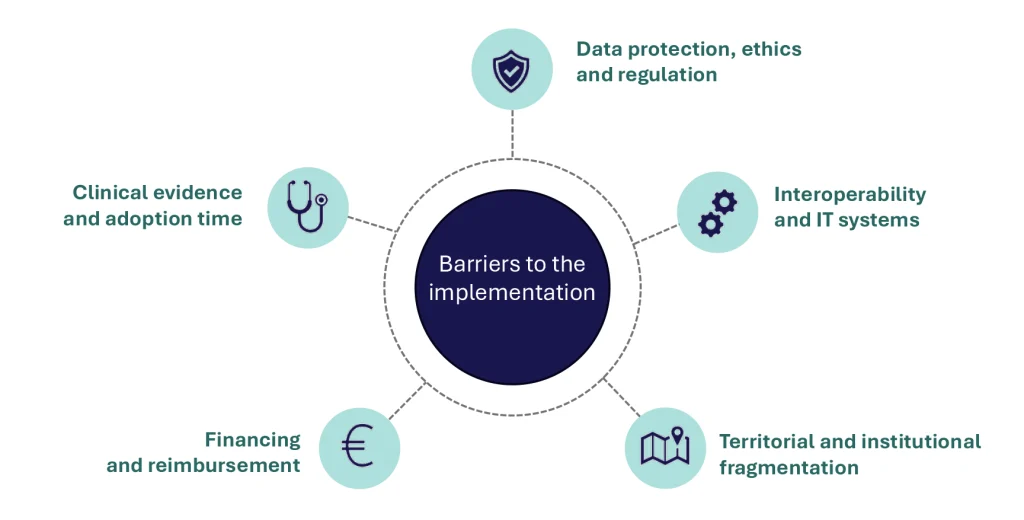
- • Data protection, ethical and regulatory requirements, which are particularly sensitive in healthcare, introduce high levels of complexity into the implementation of new digital tools.
- • Difficulties with interoperability with existing IT systems and cybersecurity requirements complicate the integration of new solutions into care environments.
- • Territorial and institutional fragmentation means that entry pathways, validation criteria and care priorities vary across territories, institutions and even centres within the same healthcare environment.
- • Public procurement funding and reimbursement models, which are still evolving in the digital health field, continue to generate uncertainty about the economic sustainability of many solutions.
- • The time required to generate clinical evidence considerably lengthens adoption and consolidation cycles within the healthcare system.
This combination of factors explains situations in which there are solutions with demand but no clear mechanisms for acquiring them. The result is an ecosystem that systematically generates innovation, but struggles to transform that innovation into real and sustained impact beyond the evidence generated by a pilot.
In the public system, many of these barriers are amplified by the complexity of administrative processes and the need to ensure equity, safety and system-wide sustainability. By contrast, private settings may show greater adoption capacity in areas linked to operational efficiency or improved user experience, although significant difficulties remain around clinical validation, technological integration and the consolidation of sustainable business models.
At the same time, it is also necessary to focus on defining the need. Not all digital solutions start from a deep understanding of the problem they aim to solve. In some cases, technology is developed without a clear connection to a specific care or patient need, or without taking into account the needs of different types of users and the basic principles of bioethics, which limits its adoption potential. In fact, many proposals fail simply because they are not aligned with the needs identified by the system or its users.
This mismatch highlights the importance of understanding the context into which any healthcare innovation is introduced. It is an environment involving multiple stakeholders—professionals, patients, caregivers, family members, institutions, companies and funders—with different interests and ways of operating. The viability of a solution depends on its ability to align with this entire ecosystem.
In this context, it is particularly important to incorporate the perspective of all stakeholders’ needs, as well as the business and implementation model, from the early stages of development. This means not only validating the technology, but also understanding how it will be adopted, who will purchase it, how it will be integrated, how professionals, patients and family members will use it, and what requirements it will have to meet in order to scale.
Integrating these elements from the outset helps reduce the gap between innovation and implementation and increases the likelihood that solutions will achieve real-world impact.
In a context in which technological innovation will continue to advance, this capacity for alignment will be a key factor. The challenge is no longer to generate more technology, but to ensure that technology is developed with a clear understanding of its pathway through the system.
Ultimately, the future of digital health will depend less on the ability to innovate than on the ability to implement. And this ability requires, beyond technology, a strategic perspective that integrates the market, processes and all the stakeholders involved.